
The prime minister said India will continue to support Nepal according to that country's priorities, adding both sides have agreed to expedite all connectivity projects.

On Monday China said it has "effectively managed and controlled" frictions in certain border areas.

The relations between the two countries have never been as good as they are now, Trump said, adding that the countries have made "wonderful deal".

India was the sole abstention while all other 14 members of the Council voted in favour of the resolution that decided that processing or payment of funds, other financial assets, economic resources, and provision of goods and services necessary to ensure the timely delivery of humanitarian assistance are permitted and are not a violation of the asset freezes imposed by the Council or its Sanctions Committee.

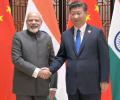
During the meeting on the sidelines of the 11th BRICS Summit on Wednesday, prime minister Modi said there was a "new direction and new energy" in bilateral ties after the two leaders' second informal summit in Chennai.

US Deputy National Security Adviser Daleep Singh also referred to the 'no limits' partnership between Moscow and Beijing and said no one believes that Russia would come running to India's defence if China breaches the Line of Actual Control.
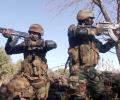
Union Minister of State for Home Nityanand Rai said as many as 5,133 incidents of ceasefire violations were reported in 2020; 3,479 in 2019; and 2,140 in 2018.

The government may soon give the green light to bilateral trade between Russia and India in their national currencies to avoid any trade disruptions, multiple people aware of the matter said. While the Department of Commerce has recommended the proposal, an announcement is likely to be made by the finance ministry after further deliberations between the Department of Economic Affairs and Department of Financial Services. "The finance ministry will take a call on how to peg the two currencies," a senior government official told Business Standard. In the past, the two nations have had rupee-rouble trade, and when such an arrangement is implemented again, it will bypass the sanctions imposed on Russia by the West.

External Affairs Ministry Spokesperson Anurag Srivastava said the diplomatic and military talks have helped both sides to enhance understanding of each other's positions on the issue.
"No one has ever accused India of supporting what is going on in Ukraine. What India seems to be doing is trying to operate within the policy outlined by Nehru 65 years back," said a source.

Colombo seems to be veering to the middle path between China and the US on global matters, but in regional matters of strategic security, it is increasingly identifying with India, points out N Sathiya Moorthy.

Pakistan on Saturday said it was not satisfied with India's 'simplistic explanation' on the 'accidental firing' of a missile that landed in Pakistan's Punjab province and demanded a joint probe to accurately establish the facts surrounding the incident.
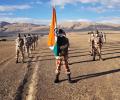
India and China on Friday agreed to hold the next round of military talks at an early date to achieve the objective of complete disengagement in remaining friction points in eastern Ladakh amid fresh sparring between the two sides on the prolonged Line of Actual Control (LAC) standoff.

Modi, in a statement before his two-day visit to Bishkek from June 13-14, said that on the sidelines of the SCO Summit, he also plans to meet several leaders, including Russian President Vladimir Putin and Chinese President Xi Jinping.
The Chinese and the Indian troops were engaged in a standoff for 73 days in Doklam.
China's national legislature -- the National People's Congress (NPC) -- on October 23 adopted the new law on the protection and exploitation of the land border areas which drew sharp reaction from India as it was passed amid the protracted military standoff between the two sides in eastern Ladakh region.

China, which has territorial disputes with many countries in the strategic Indo-Pacific region, has been opposing the Quad alliance since its formation.
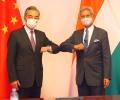
Jaishankar said full restoration and maintenance of peace and tranquillity in border areas was essential for the development of the bilateral ties.

On his maiden visit to Beijing, Pakistan Prime Minister Shehbaz Sharif held talks with Chinese President Xi Jinping during which the two leaders agreed to strengthen the all-weather friendship and the USD 60 billion China-Pakistan Economic Corridor (CPEC).
India on Thursday blamed China's actions of amassing a large number of troops close to the border and attempts to unilaterally alter the status quo along the Line of Actual Control (LAC) last year for the continuing military standoff in eastern Ladakh, and asserted that these acts were in violation of Sino-India bilateral agreements.

India said it is strongly committed to ensuring its sovereignty and territorial integrity.
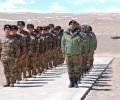
The two sides agreed that the next round of military dialogue should be held at an early date.

The external affairs ministry said the talks were 'positive'.
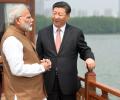
The BRI, a pet initiative of President Xi, is aimed at promoting network of roads, ports and rail networks all over the world to spread China's influence.
India on Thursday once again called for completion of the disengagement process at the remaining friction points in eastern Ladakh to pave the way for both the Indian and Chinese troops to consider de-escalation and ensure full restoration of peace and tranquillity in border areas.

The people will view it from their viewpoint, their immediate interest, historical experiences, their insecurities, he said.

The formal process of disengagement of troops began on July 6, a day after a nearly two-hour telephonic conversation between National Security Advisor Ajit Doval and Chinese Foreign Minister Wang Yi on ways to bring down tensions in the area.
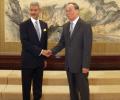
"Our relationship is so big that it is no longer a bilateral relationship. It has global dimensions," the report quoted Jaishankar as saying.

India and Italy inked 15 pacts and finalised an ambitious action plan to further expand their ties following a virtual summit between Prime Minister Narendra Modi and his Italian counterpart Giuseppe Conte that primarily focused on ramping up economic engagement.

India has told China that disengagement at all friction points is necessary to contemplate de-escalation of troops in eastern Ladakh even as the foreign ministers of the two countries agreed to establish a hotline for "timely" communication and exchange of views.
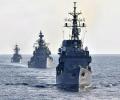
National Security Advisor Ajit Doval on Thursday called for seamless coordination among various agencies involved in protecting India's maritime interests in the face of emerging security challenges and increasing rivalries and competitions in the Indian Ocean.

The armies are working to schedule their seventh round of talks to take steps towards "early and complete" disengagement of troops along the LAC in eastern Ladakh.

Another round of diplomatic talks under the framework of the Working Mechanism for Consultation and Coordination is expected to be scheduled soon.
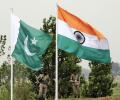
The United States, the United Nations and the European Union have welcomed the announcement by the militaries of India and Pakistan to strictly observe all agreements on ceasefire along the Line of Control (LoC) in Jammu and Kashmir and other sectors, and hoped that it would lead to greater peace and stability in South Asia.

Gen Naravane said that the Indian Army did not hide casualties during Galwan clash in eastern Ladakh as the Chinse have done.

This was the first round of talks for Wang after he succeeded State Councillor Yang Jiechi earlier this year.

Modi said India will continue its support to ASEAN for a rules-based security architecture for the region.

It is understood that India's border row with China figured in the talks between Foreign Secretary Harsh Vardhan Shringla and US Under Secretary of State for Political Affairs David Hale though there was no mention of it in the press statements issued by the two sides.
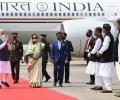
The South Asian nations could script a new history of cooperation and prosperity that could serve as an example for other nations, notes Dr Rahul Mishra.
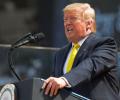
The US president previously offered to mediate between India and Pakistan, a proposal rejected by New Delhi which maintains that there is no role for any third party in bilateral issues.
